

FlowMattic Connects: one-click OAuth for apps in WordPress
A Connect stores one set of credentials for an app in your own site database, never on a FlowMattic server, and every workflow, custom app and MCP tool reuses it. For Slack, HubSpot, Mailchimp, Notion and other hosted apps, connecting means signing in and clicking Allow: no developer console, no client ID, no API key to paste.
6 credential typesTokens refreshed automaticallyStored in your site database, never on a FlowMattic serverReused by workflows, custom apps and MCP tools
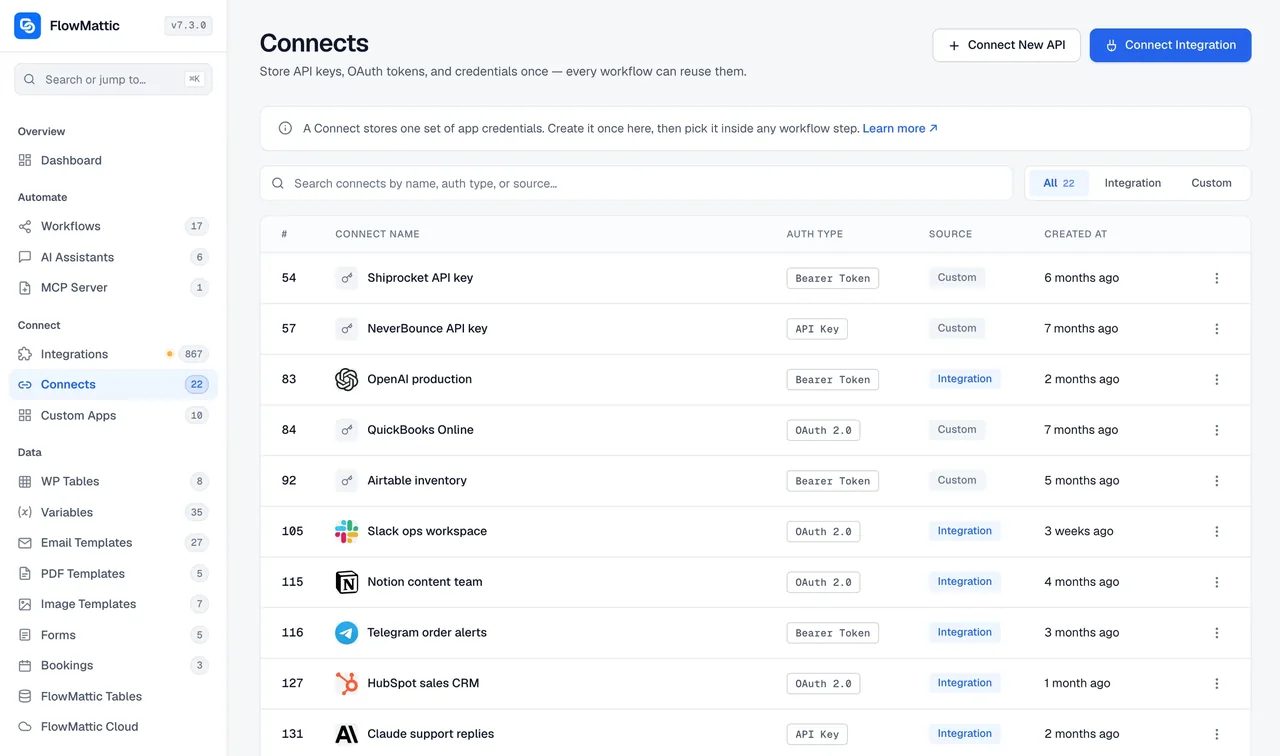
Authenticate once, pick it everywhere
The Connect is created in the admin; after that it is a dropdown in every step.
-
Choose
Connect Integration, or Connect New API
Pick the app from the integrations list, or start a Connect for any other API and choose its auth type: Basic, API Key, Bearer Token, OAuth 2.0, AWS Signature V4 or FTP and SFTP.
-
Allow
Sign in and approve, or paste a key
An OAuth app opens the provider's own consent screen; you approve and the tokens come back to your site. An API-key app takes the key once. FlowMattic keeps it in your site database.
-
Pick
Select the Connect in any step
Every workflow step for that app, every custom app action and every MCP tool offers the Connect in a dropdown. Nothing is re-entered, and renaming it is one click.
Apps that connect with a click
For these apps FlowMattic hosts the OAuth app, so there is nothing to register with the provider. Click Connect Integration, sign in, allow, and the Connect is ready.
 Slack
 HubSpot
 Mailchimp
 Notion
 Box
 Discord
 Facebook Lead Ads
 Taskade
Google Workspace apps, GitHub, Dropbox, Zoom, Shopify, Zoho and a number of others use OAuth with a client you create once in the provider's console. Paste the client ID and secret into the Connect, and from then on it is the same sign-in-and-allow flow for everyone who uses the site.
 Google Sheets
 Gmail
 Google Drive
 Google Docs
 YouTube
 GitHub
 Dropbox
 Zoom
 Shopify
 Zoho CRM
 Calendly
 Canva
 X
Facebook Pages
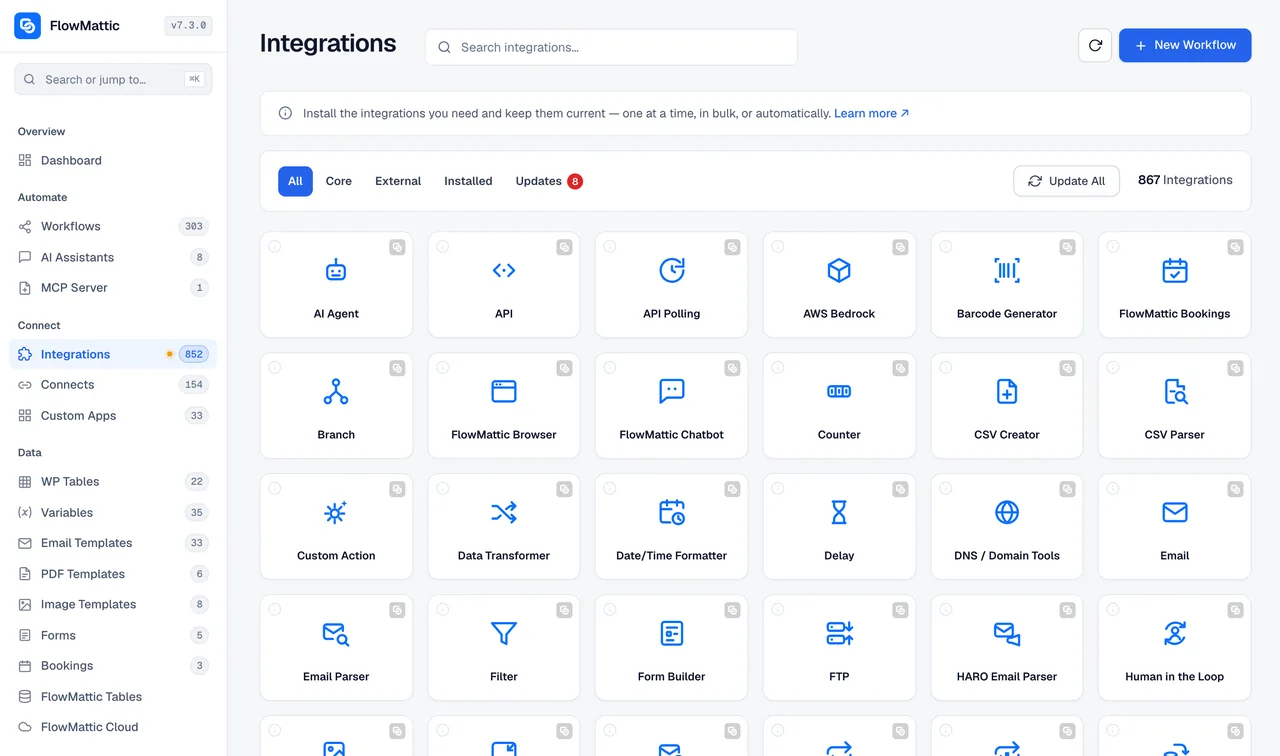
Any other API: paste a key once
Connect New API makes a Connect for a service FlowMattic has no integration for. Choose the auth type, enter the credential, and the same Connect feeds the API module, your Custom Apps and the MCP tools built on them, so a key is never typed into a step.
- Basic Auth, API Key in a header or query, Bearer Token, OAuth 2.0 with your own client, AWS Signature V4, FTP and SFTP
- Custom OAuth connects take a base URL, callback URL, client ID and client secret
- Integrations can label the API Key and Base URL fields in their own words
- Filter the list by source, integration or custom, and search by name or auth type
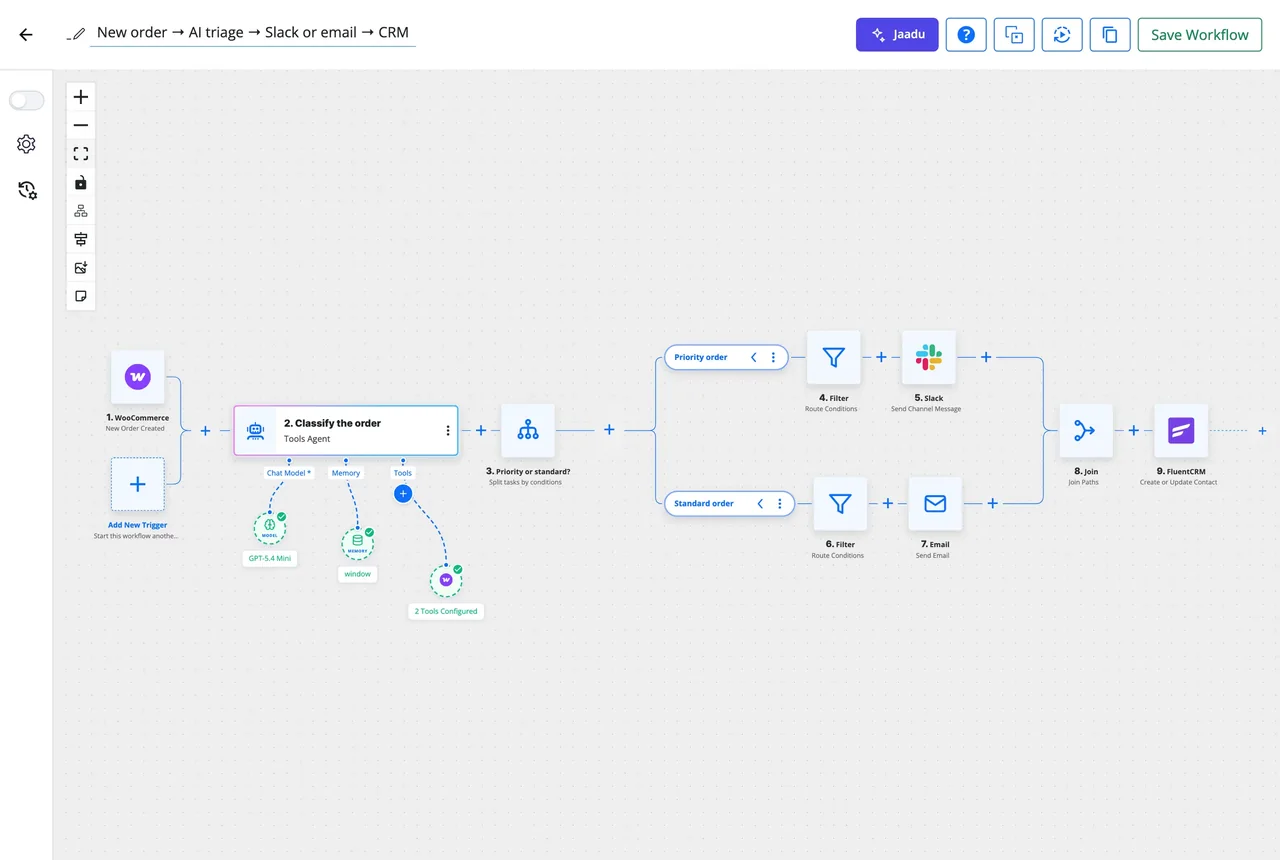
Refreshed on a schedule, reconnected in a click, revoked when you say
OAuth access tokens expire; FlowMattic schedules the refresh and retries it, so a workflow that runs at 3 am does not find a dead token. If a provider revokes access or a password changes, click Connect again on the integration to reauthorise. Delete a Connect and nothing on the site can use it.
- Refresh tokens are used on a schedule, with retries, and a failed refresh never overwrites the stored data
- Reconnect by running the one-click flow again; the Connect keeps its name and every step that uses it
- Rename, edit settings or delete from the row menu
- Tokens come back to your site, not through a browser or a third-party store, and live in your own database
What a Connect gives you
One credential, stored once, used by everything on the site that talks to that app.
One-click OAuth
For hosted apps there is no OAuth client to create. Sign in on the provider's own screen, allow, and the Connect is live.
Six credential types
Basic Auth, API Key, Bearer Token, OAuth 2.0, AWS Signature V4 for Amazon Bedrock and other AWS services, and FTP or SFTP for file steps.
Automatic token refresh
Refresh tokens are exchanged on a schedule with retries, and a refresh that fails leaves the stored Connect intact rather than blanking it.
Stored on your server, not ours
Credentials live in your own site database and never on a FlowMattic server. Only the requests you configure leave the site, Task History masks secrets in every run, and deleting the Connect removes them.
Reused everywhere
Workflow steps, the API module, Custom Apps and MCP tools all select the same Connect from a dropdown. Change the credential once and they all follow.
Per site, for agencies
Each site holds its own Connects. Import a workflow on a client site and pick that site's Connect in each step; the client's tokens never leave their install.
Questions about FlowMattic Connects
How is a Connect different from a Custom App?
A Connect stores one set of credentials: an OAuth consent, an API key, a bearer token, basic auth, AWS keys or FTP details. A Custom App defines the actions and triggers of an API and points at a Connect for its authentication. Shipped integrations work the same way.
Which apps connect without any keys at all?
The apps whose OAuth app FlowMattic hosts, including Slack, HubSpot, Mailchimp, Notion, Box, Discord, Facebook Lead Ads and Taskade. For those you click Connect Integration, sign in on the provider’s screen and allow access. Nothing is registered or pasted.
Do I ever need to register an OAuth app with a provider?
For some providers, yes, once per site. Google Workspace apps, GitHub, Dropbox, Zoom, Shopify, Zoho and a few others ask for an OAuth client you create in their developer console; you paste its client ID and secret into the Connect. After that every authorisation is the same sign-in-and-allow click.
Where are the tokens stored?
In your own WordPress database, never on a FlowMattic server. The provider sends them to your site, not through a browser or a third-party store, and Task History masks them in every run. Delete the Connect and nothing remains; the app cannot be used until someone connects again.
What happens when a token expires or a user revokes access?
Expiry is handled for you: FlowMattic refreshes OAuth tokens on a schedule, with retries, before workflows need them. If access is revoked at the provider, the next step that uses the Connect fails and Task History shows why; click Connect again on the integration to reauthorise and every step that used the Connect works again.
How does this work across an agency’s client sites?
Connects belong to the site they were made on, so each client site holds its own tokens and the client can revoke them at the provider at any time. Build a workflow once, export it as JSON, import it on the client site and pick that site’s Connect in each step.
Did not find your answer? You can browse the help center or ask us directly.
Connect the app once, then forget about credentials
Sign in, allow, and every workflow on the site can use the app. FlowMattic runs on 12,925+ sites with 918+ integrations.
30-day money-back guarantee Credentials stay on your server Unlimited workflows and runs