

Send WooCommerce orders to Google Sheet and notify customer on WhatsApp
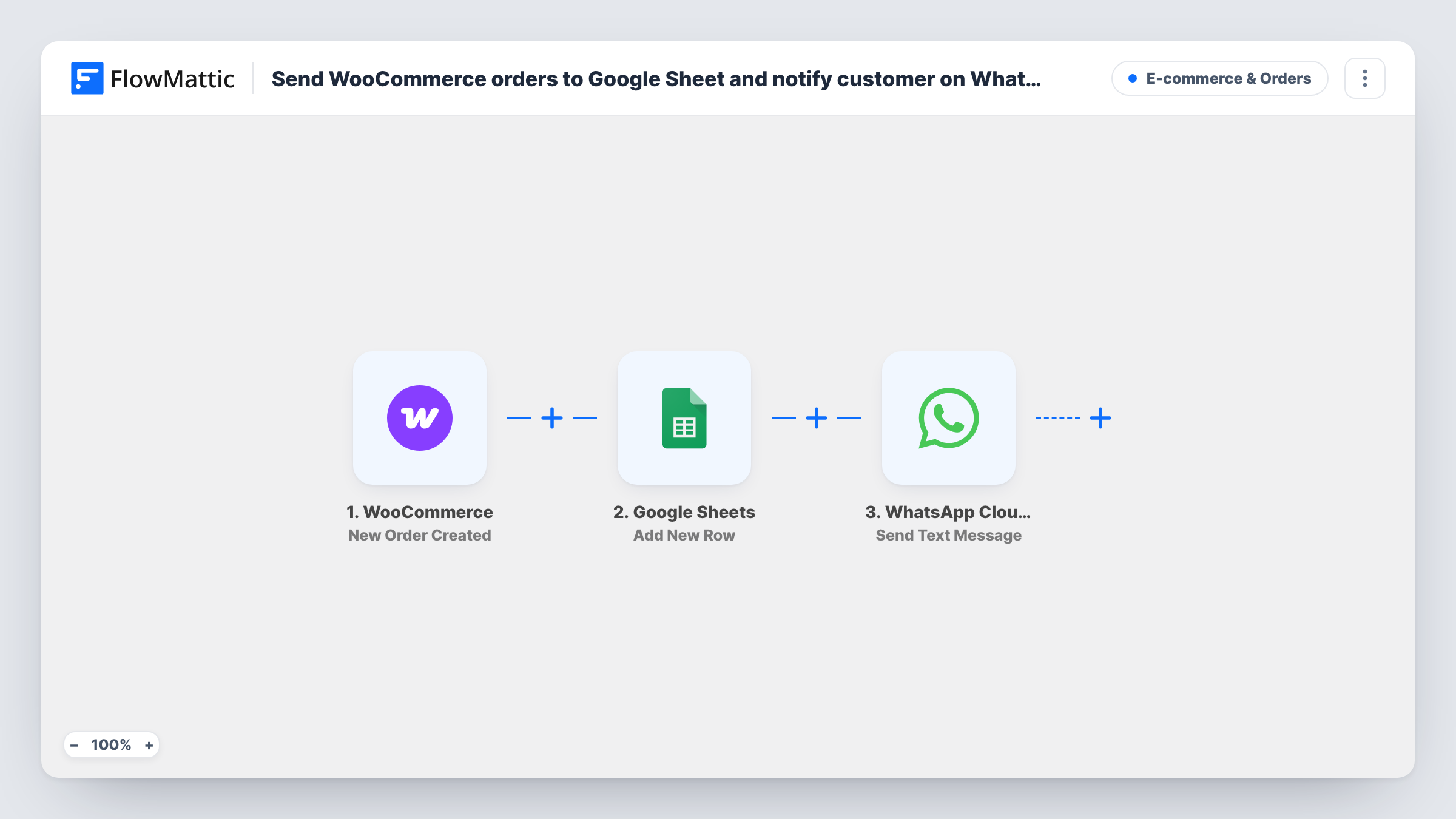
Each new WooCommerce order is added as a row to your Google Sheets spreadsheet, then the customer gets a WhatsApp message thanking them and quoting their order number.
 WooCommerce
 Google Sheets
 WhatsApp Cloud API
3 steps 98 downloads Setup ~5 min Used on 3.1k sites Revenue Ops Free to import
What this workflow does
Store owners often want two things the moment an order comes in: a running record they can sort and share outside WordPress, and a quick personal note to the buyer. This workflow does both from one trigger, so neither depends on someone checking the orders screen.
The WooCommerce trigger starts a run when a new order is created and passes the order data on. The Google Sheets step then adds one row for the order. It ships without column mapping, so after import you pick the spreadsheet and sheet and choose which order fields go into which columns, such as the order number, customer name and total.
The last step uses WhatsApp Cloud API to send a text message to the billing phone on the order. The message is already written: it greets the customer by first name, thanks them and quotes the order number. You can edit the wording before you turn the workflow on.
Each order produces one row, not one row per product. WhatsApp also has its own messaging rules: free-form text messages are generally only delivered inside the 24-hour window after a customer last messages your business number. Test with a real order and check Task History to see what each step returned.
Order log the whole team can open
A small shop keeps every order in a shared Google Sheet so the packing team and the bookkeeper can filter by date or total without logging in to WordPress.
Thank-you note on the buyer's phone
Customers who chat with the store on WhatsApp before buying get a short thank-you with their order number as soon as they check out.
Daily sales review in a spreadsheet
The owner sorts the sheet each evening to see the day's orders and totals, and adds their own columns for notes or follow-ups.
How this workflow runs
What happens at each step once the workflow is on, and what you need before you import it.
 WooCommerce New Order Created
Starts the workflow each time a new order is created in WooCommerce. The order details, including the billing name, phone number and order number, are passed to the next steps.
- Google Sheets Add New Row
Adds one row to the spreadsheet you choose for each order. No columns are mapped in the template, so connect your Google account, pick the sheet and map the order fields you want to keep.
- WhatsApp Cloud API Send Text Message
Sends a WhatsApp text to the order's billing phone number. The message greets the customer by first name and includes the order number; you can reword it before going live.
What you need
- FlowMatticCore
- WooCommerce PluginPlugin
- Google Sheets AccountAccount
- WhatsApp Cloud API AccountAccount
After importing, map your own data. To keep the template universal, not every step is pre-filled. Open each step in the builder and connect your accounts and fields (channels, lists, sheets, recipients) before you switch the workflow on.
Make it yours
Changes worth making after you import it.
- Swap Send Text Message for the Send Template Message action if you need to reach customers who have not messaged your WhatsApp number in the last 24 hours.
- Make sure your checkout collects phone numbers with the country code, since WhatsApp needs the full international number to deliver the message.
- Put a Filter between the Google Sheets step and the WhatsApp step that continues only when the billing phone is not empty. Every order still gets its row, and orders without a number stop before the message.
- Map the order date and order total into columns of their own, so you can sort the sheet by day and add a total formula at the bottom.
Questions about this workflow
Does each product in an order get its own row?
No. As imported, the workflow adds one row per order. For a row per product, put an Iterator over the order's line items between the trigger and the Google Sheets step, and end the loop before the WhatsApp step so the customer gets one message.
Which columns end up in the Google Sheet?
The ones you map. The template leaves the Add New Row step unmapped, so after import you choose the spreadsheet and match order fields to your column headers.
Will every customer receive the WhatsApp message?
Only if the billing phone is a valid WhatsApp number in international format and WhatsApp accepts the message. Free-form text is normally limited to customers who messaged you in the last 24 hours, so check Task History for the response.
Can the WhatsApp wording be changed after import?
Yes. The text is written into the step with the customer's first name and order number mapped in. Edit it in the Send Text Message step and map any other order field you want.
More E-commerce & Orders workflows
Other ready-to-import templates from the same category.





Import this workflow into your WordPress site
Download the JSON, import it from the Workflows screen and connect your accounts. Every run stays on your server, with no per-task fees.
30-day money-back guarantee Unlimited workflows and runs Self-hosted