FTP automation in WordPress: upload, download and watch folders
The FTP app uploads, downloads, moves and deletes files on FTP, FTPS and SFTP servers from any workflow, and starts workflows when…


Multiple triggers in one workflow means a single chain of steps can start from several events: a form submission, a webhook from a partner, a schedule or a WordPress event. FlowMattic’s multi-trigger workflows let you add as many triggers as a process needs and map each one onto the first trigger’s field names, so the steps after them never need to know which event started the run.
It is for anyone who has built the same workflow twice because data arrives from two places. One workflow per process keeps the list short and means a fix to a step is a fix for every source.
Every workflow in the visual builder starts with one trigger. Beside it on the canvas sits a dashed Add New Trigger box labelled “Start this workflow another way”. Click it, pick an app and event, and the new trigger joins the first one. The builder numbers them 1.1, 1.2, 1.3 and so on, and every trigger’s connector merges into the same first step.
The first trigger has a special role. Its captured fields become the names your action steps use. Every additional trigger keeps its own settings, its own captured response and its own map that translates its fields onto those names.
email and first_name become the contract.
FlowMattic rewrites the incoming data onto the first trigger’s keys before any step runs. A row that holds exactly one token, such as {trigger.customer_email}, passes the value through unchanged, so a list stays a list. A row that mixes text and tokens, such as {trigger.fname} {trigger.lname}, builds a string, and any token with no value becomes empty. The steps then run exactly as they would for the first trigger.
Task History shows where each run came from: the trigger step’s title gains “(via 1.2 …)” with the event name of the trigger that fired.
Each trigger keeps its own Conditions tab. When trigger 1.2 fires, its conditions and its Skip Duplicate Events settings apply, not those of trigger 1.1. A partner webhook can therefore be filtered to one event type while the form trigger accepts everything.
| Option | What it does |
|---|---|
| Add New Trigger | Adds trigger 1.2, 1.3 and onwards beside the first trigger. |
| Map rows | One row per key of the first trigger’s captured response. Each row’s value becomes that key when this trigger fires. |
{trigger.key} | Inserts a key from this trigger’s own response. The insert button lists them once a response is captured. |
| Static text | Any plain value, for when this trigger has no matching field. |
| Auto-map matching keys | Fills empty rows whose key name exists in both responses. |
| Conditions tab | Per-trigger filters and Skip Duplicate Events, read from the trigger that fired. |
| Delete | Removing a trigger renumbers the rest, so 1.3 becomes 1.2. |
The website form is trigger 1.1 and a partner’s webhook is 1.2, with customer_email mapped to email. Every lead passes through the same AI scoring and lands in the CRM with the same tags.
Form Builder · Webhook → AI Agent → Router → FluentCRM · Slack
WooCommerce orders are the first trigger. Payments taken outside the shop arrive on a webhook mapped onto the order’s field names, and both reach the same invoice and thank-you steps.
WooCommerce Order Paid · Webhook → Generate PDF from Template → Send Template Email
A Schedule trigger runs the weekly report every Monday. A webhook trigger runs the same steps whenever a manager asks for an update mid-week.
Schedule · Webhook → WP Tables: get rows → AI Agent → Send Email
An agency watches Plugin Updated, Theme Switched and WordPress Core Updated in one workflow. The log table and the Slack message are configured once.
Plugin Updated · Theme Switched · WordPress Core Updated → WP Tables → Slack
A SaaS team takes requests from a contact form and from its in-app help widget’s webhook. An AI Agent classifies both, and the same Router sends them to the right queue.
Form Builder · Webhook → AI Agent → Router → Slack · Email
New Post and Update Post (filtered to published posts) share one workflow that tells the team what changed and logs it in the content calendar.
New Post · Update Post → Telegram → Google Sheets
Most surprises with multiple triggers in one workflow come from which trigger goes first and what the map carries:
See examples and the canvas in action on the multi-trigger workflows page.
Yes. Click Add New Trigger beside the first trigger on the canvas to add trigger 1.2, 1.3 and onwards. All of them run the same chain of steps.
Map them once. On each additional trigger’s Capture tab, every key of the first trigger is a row, and you insert the matching key from the new trigger, such as {trigger.customer_email} for email. Auto-map matching keys fills the rows whose names already agree.
Task History labels the trigger step with “(via 1.2 …)” and the event name of the trigger that fired. Runs started by the first trigger look the same as in a single-trigger workflow.
No, each trigger has its own. The Conditions tab and Skip Duplicate Events settings of the trigger that fired are the ones applied to that run.
Yes. Workflow generation understands multi-trigger workflows and writes each additional trigger with its map onto the first trigger’s fields. Review the map on each trigger’s Capture tab before you switch the workflow on.
One process, one workflow, however many ways in. Try FlowMattic and add a second trigger on a live demo site.
The FTP app uploads, downloads, moves and deletes files on FTP, FTPS and SFTP servers from any workflow, and starts workflows when…
Share Secrets turns a password or API key into a link that expires after a set time, a set number of views,…
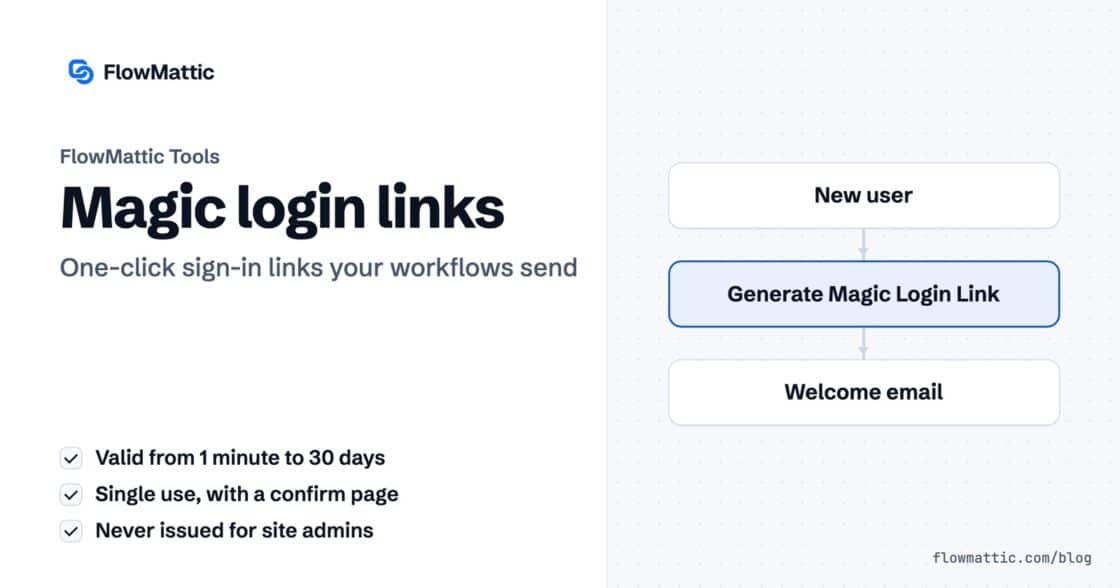
Generate Magic Login Link creates single-use sign-in links from any workflow, valid from 1 minute to 30 days, with a confirmation page…