

Arrays in, JSON out: two decisions that make an AI step usable
Every morning you want the same email: what happened yesterday, in two sentences, and what to do about it. So you point an AI at your abandoned carts table and ask it to summarise.
Back comes a paragraph. A perfectly nice paragraph — that you cannot put in a subject line, cannot count, cannot branch on, and cannot map into anything.
Two decisions fix that: what the model is allowed to see, and what shape it has to answer in.
Decision one: what it sees
WP Tables → Find Multiple Records hands you rows. Whole rows. Every column you ever created — session hashes, internal ids, a raw payload blob. Fourteen columns, when the model needs four.
So you loop them, and inside the loop Iterator Storage → Store as Array is where you choose. Not a string this time: Data Parameters, a key and a value, one pair per field you actually want.
name          {iterator3.name}
email         {iterator3.email}
cart_total    {iterator3.cart_total}
abandoned_at  {iterator3.abandoned_at}
Four keys, chosen by you, built one pass at a time. Everything else never reaches the model — it can’t misread what it was never given, and you aren’t paying for it either.
After Iterator End, what comes out is one clean array: nine carts, four fields each.
Decision two: what it answers with
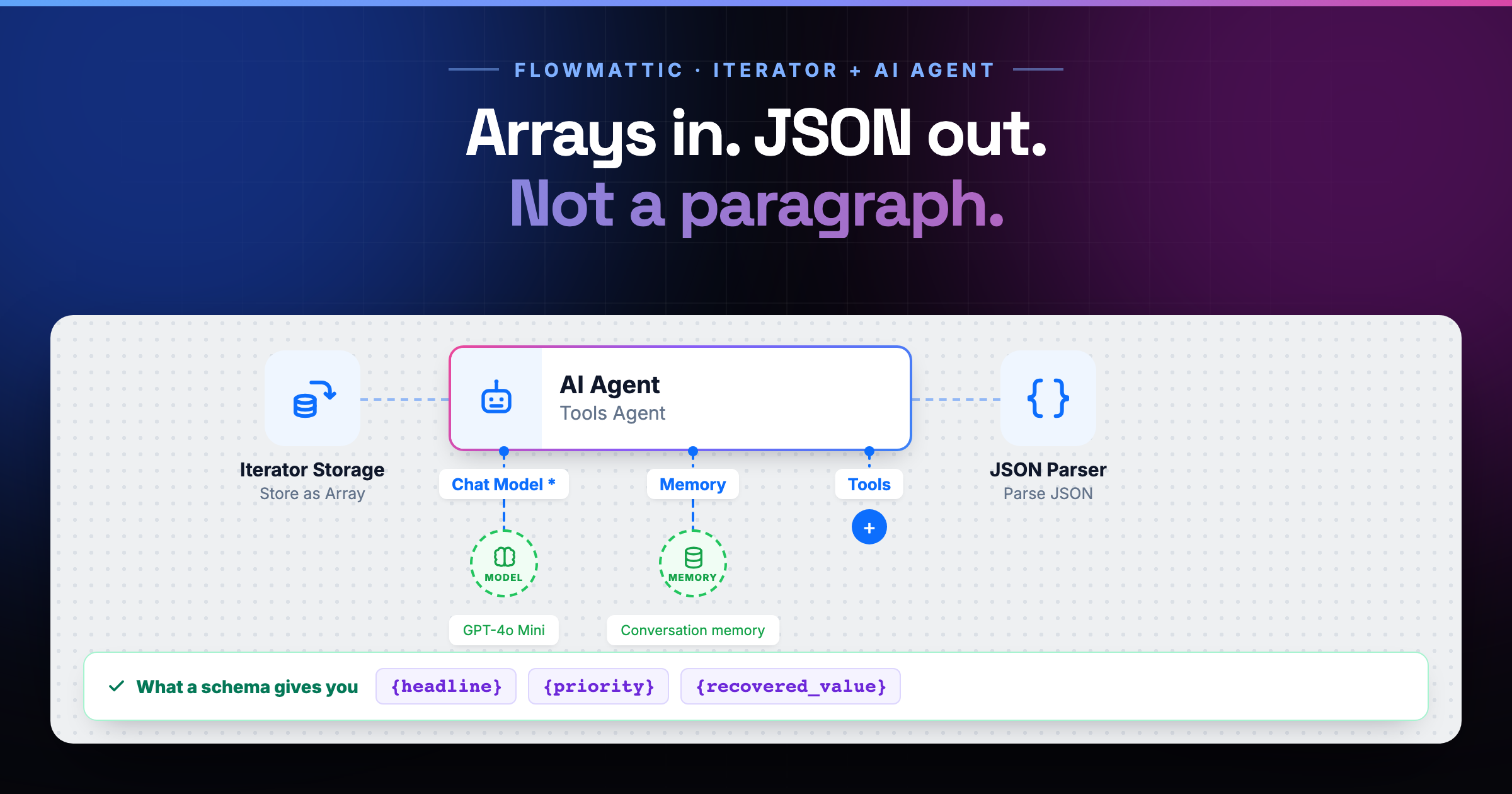
In the AI Agent step, System Prompt is the job and User Input / Message is the array you just built — {iterator_storage4.data}. Structured data in, not a wall of table dump.
Then set Output Format to JSON, and a field appears that wasn’t there a second ago: JSON Schema. Its help text is the whole idea — “Define the JSON structure for consistent output. The AI will use these exact keys.”
{
  "headline": "string",
  "priority": "string",
  "recovered_value": "number"
}
That isn’t a hint to the model. FlowMattic appends it to the system prompt as “You must respond with valid JSON matching this exact structure”. It’s a contract.
Watch it built
The eight steps, both decisions, and a full run in four minutes:
The part everybody trips over
You set the schema, the agent obeys it, and you still can’t drop headline into a subject line. Here’s why.
The agent step returns status, message, finish_reason, usage and iterations. Your JSON arrives inside message — as one string. There is no {ai_agent6.headline}, because the keys were never exploded into fields.
One step fixes it. JSON Parser → Parse JSON, pointed at {ai_agent6.message}, does exactly what it says on the tin: “Parse JSON data and extract all keys as individual fields.”
Now every key you defined is something you can use anywhere below it — {json_parser7.headline}, {json_parser7.priority}, {json_parser7.recovered_value}.
Which makes the last step boring
Email → Send Email. Subject line: the headline. Body: the summary, the priority, the number. Nothing clever left to do.
Boring is the goal. Boring is what runs every morning without you.
Two decisions, that’s all
- Store as Array decides what the model sees.
- JSON Schema decides what shape you get back.
Get those two right and an AI step stops being a black box that returns prose, and starts being a component you can wire into anything else — same as every other step in the workflow. Which is the whole point.
New to FlowMattic? It’s the AI-native automation platform for WordPress — visual workflows, 800+ integrations, AI agents and a full builder suite, self-hosted inside your own dashboard. Get FlowMattic.