

Create a HubSpot CRM contact from each new Assembly client
When you add a client in Assembly, this workflow creates a matching contact in HubSpot CRM, so the people you serve through your client portal also appear in your CRM records.
 Assembly
 HubSpot CRM
2 steps Setup ~5 min Used on 3.0k sites Free to import
What this workflow does
Assembly is where your clients log in, sign contracts and share files. HubSpot is often where the rest of the business tracks relationships, sends emails and reports on accounts. Keeping both lists in step by hand means re-typing every new client.
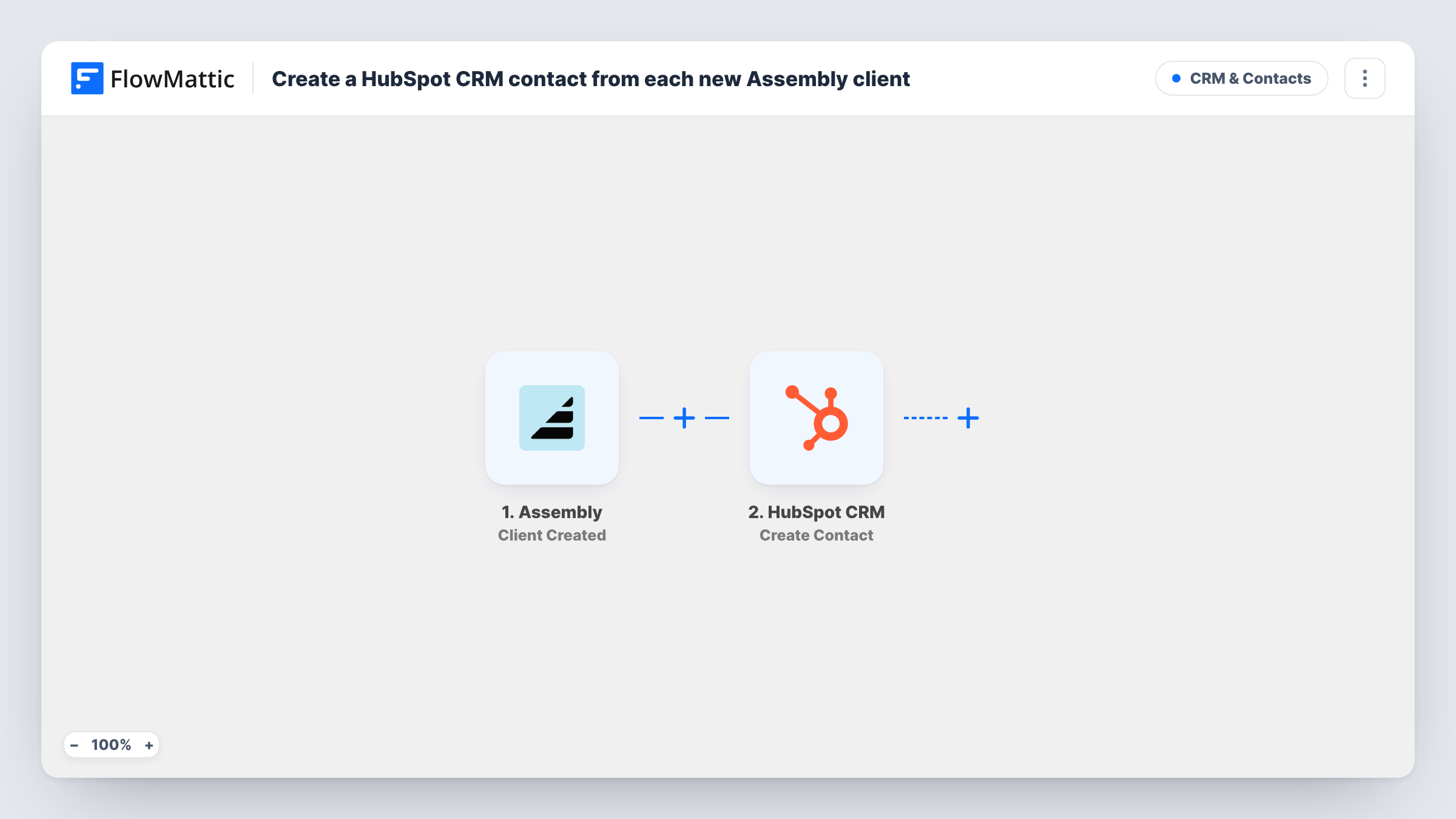
The Assembly Client Created trigger fires when a client is created in your workspace. FlowMattic passes the client's details to HubSpot CRM, where the Create Contact action adds a contact. You map Assembly fields, such as the client's name and email, into the contact.
The HubSpot step makes new contacts and never searches for an existing one. If the client's email is already in HubSpot, HubSpot may turn the request down, and you can read its reply in Task History. Later changes to the client in Assembly don't reach HubSpot, because the workflow only reacts to new clients.
Agencies onboarding new accounts
Your account manager adds a client in Assembly to open their portal. The same person appears in HubSpot, ready for the sales or success team to log calls and emails.
Accounting firms with client portals
Each new client set up in Assembly for document exchange also becomes a HubSpot contact, so newsletters and renewal reminders reach them from your CRM.
Coaches tracking client history
A coach creates a client in Assembly after the first paid session. HubSpot gets the contact, giving one place to note how the relationship develops.
How this workflow runs
What happens at each step once the workflow is on, and what you need before you import it.
 Assembly Client Created
Fires when a client is created in Assembly. The client's details are passed on for mapping. Create a test client to see which fields Assembly sends.
- HubSpot CRM Create Contact
Adds the new Assembly client to HubSpot CRM as a contact. Connect HubSpot on import and map the Assembly client fields, such as the email address and name, into the contact.
What you need
- FlowMatticCore
- Assembly AccountAccount
- HubSpot CRM AccountAccount
After importing, map your own data. To keep the template universal, not every step is pre-filled. Open each step in the builder and connect your accounts and fields (channels, lists, sheets, recipients) before you switch the workflow on.
Make it yours
Changes worth making after you import it.
- Make sure the Assembly client email is mapped to the HubSpot email field. HubSpot uses email to tell contacts apart, so a contact without one is hard to match later.
- Pair Assembly's Company Created trigger with HubSpot's Create Company action in a second workflow if you also want client companies in your CRM.
- Add a Filter after the trigger that continues only when the client's email is not empty, so HubSpot never gets a contact with no address.
Questions about this workflow
What if the Assembly client is already a HubSpot contact?
The template has no lookup step before the HubSpot action. A contact with the same email may be rejected by HubSpot, and the run's entry in Task History holds HubSpot's answer. Existing HubSpot contacts are never changed by this workflow.
Do Assembly clients created before I import this reach HubSpot?
No. Only clients created in Assembly after the workflow is turned on start a run.
Does Assembly need to be connected to HubSpot directly?
No. FlowMattic connects to each app separately. You connect Assembly for the trigger and HubSpot CRM for the contact step.
Does editing a client in Assembly change the HubSpot contact?
No. The trigger is Client Created, so the workflow runs once when the client is added. Later edits in Assembly stay in Assembly.
More CRM & Contacts workflows
Other ready-to-import templates from the same category.




Import this workflow into your WordPress site
Download the JSON, import it from the Workflows screen and connect your accounts. Every run stays on your server, with no per-task fees.
30-day money-back guarantee Unlimited workflows and runs Self-hosted