

Create a HubSpot CRM contact from each MoEngage event
Each event MoEngage sends to your FlowMattic webhook creates a contact in HubSpot CRM from the user details you map, so people your engagement campaigns reach also show up in your CRM.
 MoEngage
 HubSpot CRM
2 steps Setup ~5 min Used on 2.1k sites Free to import
What this workflow does
MoEngage knows a lot about how people use your app or site: who signed up, who clicked a campaign, who reached a key step. Your sales or success team often works in HubSpot instead. This workflow sends people from MoEngage events into HubSpot as contacts.
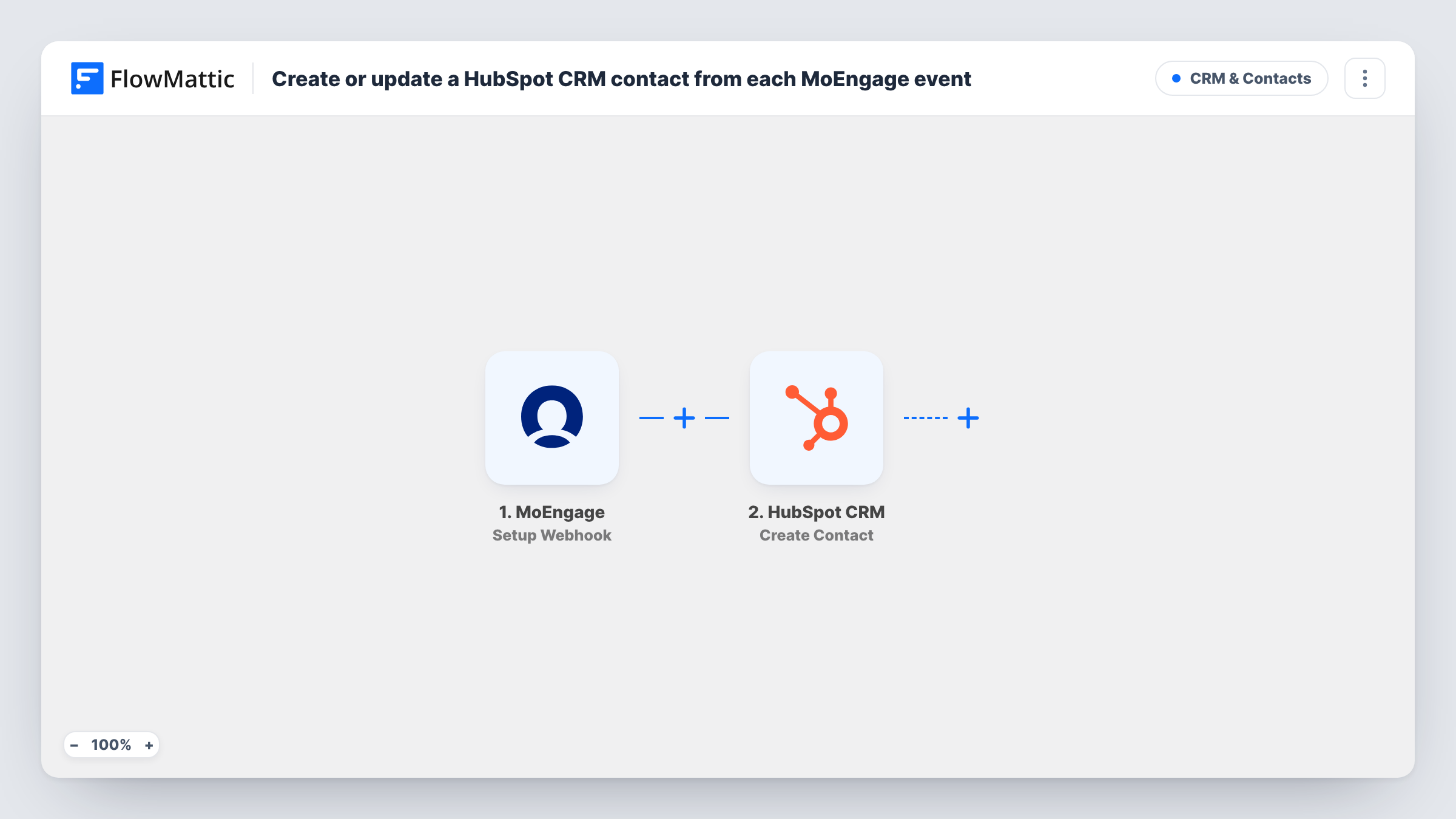
The MoEngage trigger is Setup Webhook, which FlowMattic describes as firing when an event occurs in MoEngage. You choose which events MoEngage sends to the webhook URL, and every event that arrives starts a run. Send only the events that should produce a contact, such as a sign-up or a lead event, rather than every activity. Run one test event to see which user details come with it.
Each event is then handed to Create Contact in HubSpot CRM, which ships unmapped, so after import you connect HubSpot and map the email address, name and any other user attributes from the MoEngage event into the contact. Nothing here updates an existing contact, and HubSpot may refuse an email it already holds, and Task History shows that response.
Because the same person can trigger many events, a busy event type means many attempts for one email. Choosing a single, once-per-person event in MoEngage keeps the runs meaningful.
App sign-ups for a sales team
A SaaS company sends MoEngage's sign-up event to the webhook, and each new user appears in HubSpot for the sales team's outreach.
High-intent actions from campaigns
A marketing team sends a MoEngage event for people who request a demo inside the app, so those users become HubSpot contacts for follow-up.
Lead capture from in-app forms
An e-commerce app collects interest through a MoEngage in-app form and sends that event to FlowMattic to create the contact in HubSpot.
How this workflow runs
What happens at each step once the workflow is on, and what you need before you import it.
 MoEngage Setup Webhook
Receives the events MoEngage sends to your FlowMattic webhook URL. Set MoEngage to send only the events that should create a contact, then send a test to see the user details included.
- HubSpot CRM Create Contact
Creates a HubSpot CRM contact from the MoEngage event. The step ships unmapped: connect HubSpot and map the email and name. HubSpot may reject an email that is already a contact.
What you need
- FlowMatticCore
- MoEngage AccountAccount
- HubSpot CRM AccountAccount
After importing, map your own data. To keep the template universal, not every step is pre-filled. Open each step in the builder and connect your accounts and fields (channels, lists, sheets, recipients) before you switch the workflow on.
Make it yours
Changes worth making after you import it.
- Have MoEngage send a single event type to this workflow, such as sign-up, so each run is about a person you actually want in HubSpot.
- Put a Filter between the MoEngage trigger and the HubSpot step that continues only when the event carries an email address, so anonymous events don't reach HubSpot.
- If your HubSpot account has a property for lead source, map the MoEngage event name into it, so you can see later which event brought each contact in.
Questions about this workflow
Which MoEngage events create HubSpot contacts?
Whichever events you set MoEngage to send to the webhook URL. Every event that arrives starts a run, so pick events that happen once per person.
What if the MoEngage user is already a HubSpot contact?
This template never updates contacts, so HubSpot may turn down the repeated email. The run's entry in Task History shows the reply.
Does the MoEngage webhook include the user's email?
That depends on the event and the user attributes MoEngage includes. Send a test event and look at the trigger data before mapping the HubSpot contact.
More CRM & Contacts workflows
Other ready-to-import templates from the same category.







Import this workflow into your WordPress site
Download the JSON, import it from the Workflows screen and connect your accounts. Every run stays on your server, with no per-task fees.
30-day money-back guarantee Unlimited workflows and runs Self-hosted