

Send webhook POST requests for new JetFormBuilder submissions
Each JetFormBuilder submission on your WordPress site is sent as a JSON POST request to a webhook URL you choose, so your own app, a no-code tool or a serverless function gets the form data.
 JetFormBuilder
 Webhook Outgoing
2 steps Setup ~5 min Used on 2.3k sites Free to import
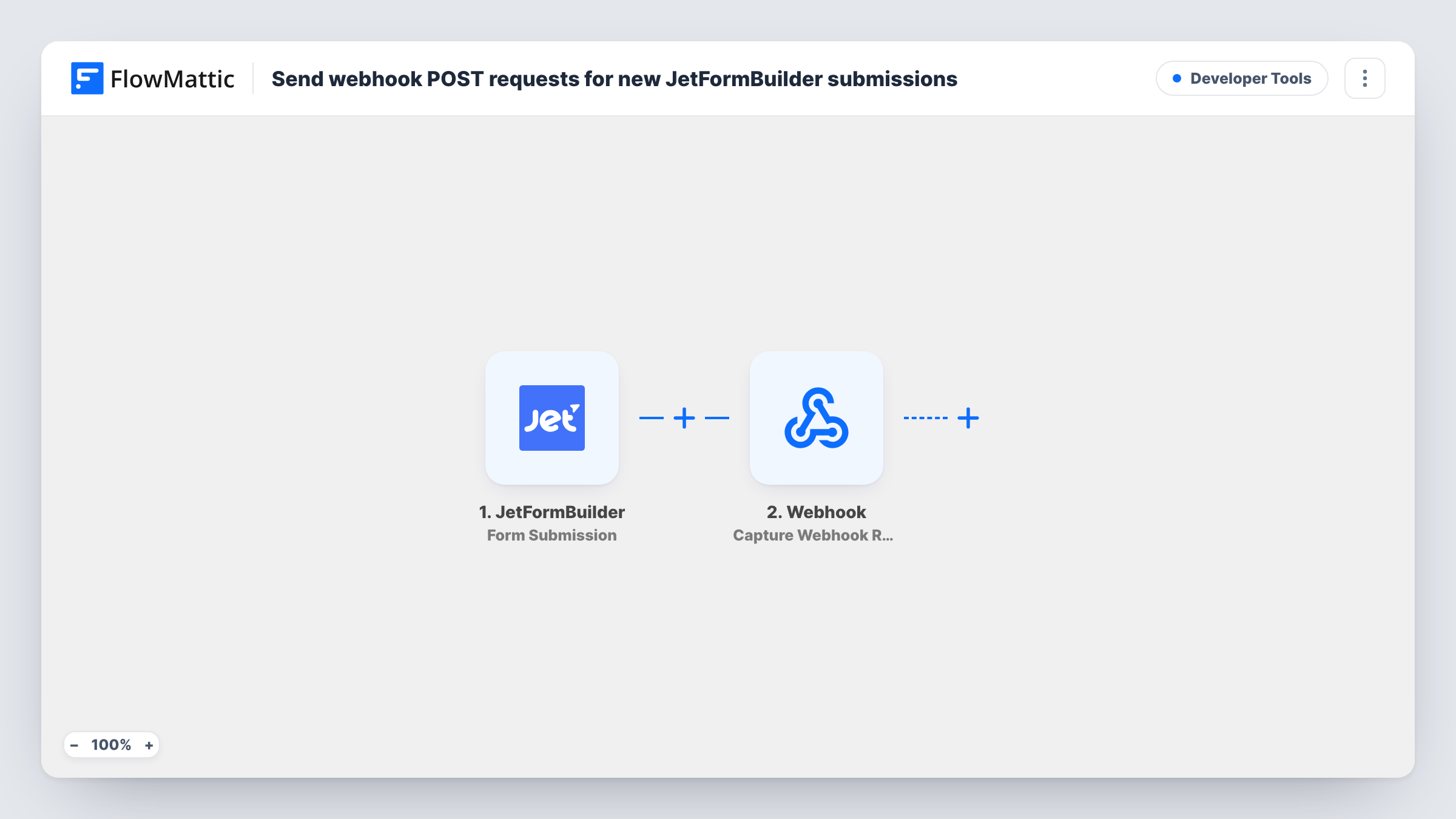
What this workflow does
Sometimes the place that needs your form entries has no ready-made FlowMattic app: an in-house system, a custom API or a webhook URL from another automation tool. As long as it accepts a webhook, this workflow can deliver every JetFormBuilder entry to it.
The JetFormBuilder Form Submission trigger starts a run each time a form is submitted on your site. The submitted values are passed to the next step, ready to be included in the request.
The Webhook Outgoing step, Submit Data to Webhook, sends that data to a webhook URL with the POST method, formatted as JSON. The template doesn't include a URL or any data, so after import you paste in the receiving address and map the form values you want the other system to get.
Each submission produces one request. Point the step at a test endpoint first, or at the receiving system's own test mode, and submit the form yourself. Task History then shows the form values FlowMattic captured and the response the webhook URL sent back, so you can confirm the receiver accepted the data before real entries flow through.
Feeding a custom booking system
An agency's client runs a bespoke booking app with a webhook endpoint, and every JetFormBuilder booking request is posted straight to it.
Handing entries to another automation tool
A team that also uses a separate automation service sends JetFormBuilder entries to that service's incoming webhook URL, which starts that tool's own automation.
Logging to a serverless function
A developer posts each form entry to a cloud function that validates the data and stores it in the company's own database.
How this workflow runs
What happens at each step once the workflow is on, and what you need before you import it.
 JetFormBuilder Form Submission
Starts the workflow whenever someone submits a JetFormBuilder form on your site. The submitted field values are passed on to be included in the webhook request.
- Webhook Outgoing Submit Data to Webhook
Sends the data as a JSON POST request to the webhook URL you enter. The template ships empty, so add the receiving URL and map the JetFormBuilder fields that should be part of the request.
What you need
- FlowMatticCore
- JetFormBuilder AccountAccount
After importing, map your own data. To keep the template universal, not every step is pre-filled. Open each step in the builder and connect your accounts and fields (channels, lists, sheets, recipients) before you switch the workflow on.
Make it yours
Changes worth making after you import it.
- Use clear key names when you map fields, such as email and full_name, so the receiving system can read the JSON without guessing which value is which.
- If the receiver expects a secret or token, check its documentation for how to send it and test with a single entry before going live.
- To post only some entries, put a Filter between the JetFormBuilder trigger and the webhook step on a form field, for example a dropdown answer.
- Include a fixed value naming the form in the request, so a receiver that gets data from several forms can tell them apart.
Questions about this workflow
In what format does the webhook receive JetFormBuilder data?
Submit Data to Webhook sends the values you map as JSON using the POST method. If your receiver needs a different method or format, use API by FlowMattic for that request instead.
Do all JetFormBuilder fields go into the request automatically?
No. The step ships without any mapping, so only the fields you add are sent. Map each value the receiving system needs.
How can I check the webhook received the form entry?
Submit a test entry and look at that run in Task History. It shows what was sent and the response the receiving URL returned, including any error message it gave.
Can one JetFormBuilder entry be sent to two webhook URLs?
Yes. Add a second Submit Data to Webhook step after the first one and point it at the other URL, mapping the same form values.
More Developer Tools workflows
Other ready-to-import templates from the same category.




Import this workflow into your WordPress site
Download the JSON, import it from the Workflows screen and connect your accounts. Every run stays on your server, with no per-task fees.
30-day money-back guarantee Unlimited workflows and runs Self-hosted