

When an agent replies to a conversation, update user meta in WordPress
When a ThriveDesk agent replies to a conversation, FlowMattic finds the customer’s WordPress account by email and updates the user meta you choose. Customers with no account are skipped.
 ThriveDesk
 WordPress
 Filter
4 steps Setup ~8 min Used on 1.3k sites Free to import
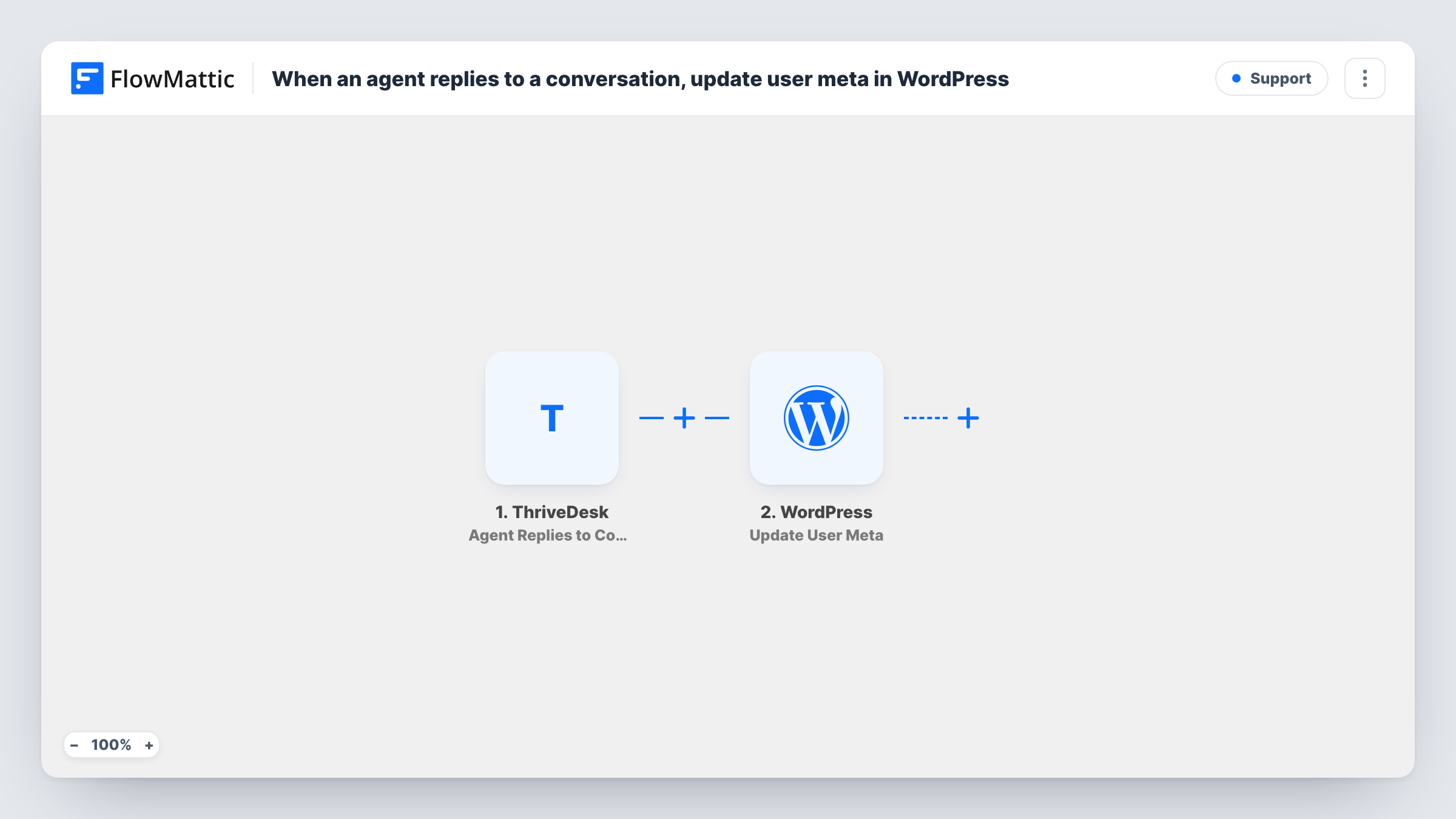
What this workflow does
Support history is useful inside WordPress too. If your membership, course or store logic reads user meta, you may want it to know when someone last heard back from your team, or which agent handled them. This workflow writes that kind of value onto the customer's WordPress profile each time an agent answers in ThriveDesk.
The ThriveDesk trigger fires whenever an agent replies to a conversation, and passes the conversation data on. The first WordPress step looks up a user by email. It ships unmapped, so after import you map the customer's email from the ThriveDesk event into it.
A Filter then continues only if that lookup returned a user ID. When nobody on your site has that email, FlowMattic gets a "user not found" response, the user ID is empty and the run stops at the Filter. When a user is found, the last step updates their meta. The template already passes the user ID from the lookup; you add the meta keys and the values to store, such as the reply date from the trigger.
Every agent reply starts a run, so a long conversation updates the same user several times. That suits values like "last reply", which should change each time, and you can follow every lookup and update in Task History.
Last support contact on the member profile
A membership site stores the date of the latest ThriveDesk agent reply in user meta, so its account dashboard can show when support last answered.
Agent name for account managers
A SaaS business writes the replying agent's name into a meta key, which its WordPress admin columns display next to each customer.
Flag customers who are in a support thread
A course site sets a meta value when an agent replies, and its own code uses that value to show a notice inside the student area.
How this workflow runs
What happens at each step once the workflow is on, and what you need before you import it.
 ThriveDesk Agent Replies to Conversation
Starts each time an agent replies to a conversation in ThriveDesk. Every reply is a separate run, and the conversation and customer details from the event are available to the later steps.
- WordPress Get User by Email
Looks up a WordPress user by email address. The step ships unmapped: map the customer's email from the ThriveDesk event so FlowMattic searches your site for a matching account.
- Filter Continue If Condition Meet
Continues only if the lookup returned a user ID. When no WordPress account has that email, the ID is empty and the run stops here, so the meta update never runs for unknown customers.
- WordPress Update User Meta
Updates user meta on the account found in step 2, using its user ID, which the template already maps. Add the meta keys and the ThriveDesk values to store in them after import.
What you need
- FlowMatticCore
- ThriveDesk AccountAccount
After importing, map your own data. To keep the template universal, not every step is pre-filled. Open each step in the builder and connect your accounts and fields (channels, lists, sheets, recipients) before you switch the workflow on.
Make it yours
Changes worth making after you import it.
- Use a meta key with your own prefix, such as one starting with your site's short name, so the value can't clash with keys that other plugins already store on users.
- Map a value that changes with each reply, such as the reply time, into the meta field. If the value stays the same, WordPress has nothing to change and the step reports that no value was updated.
- If customers write in from a different email than their WordPress login, the lookup won't find them. Check Task History for runs that stopped at the Filter to spot those cases.
Questions about this workflow
What happens when the ThriveDesk customer has no WordPress account?
The Get User by Email step returns a "user not found" message with no user ID, so the Filter stops the run and no meta is written. Nothing is created on your site.
Which user meta does this workflow update?
The keys you add. The template only maps the user ID from the lookup into Update User Meta, so after import you choose the meta keys and map the ThriveDesk values for each one.
Does it run for customer replies in ThriveDesk too?
No. The trigger is Agent Replies to Conversation, so only replies from your team start a run. FlowMattic's ThriveDesk integration has a separate Customer Replies to Conversation trigger if you need that.
Can the meta key be one that doesn't exist on the user yet?
Yes. WordPress adds a user meta key when you update one the user doesn't have yet, so a new key appears on the profile after the first matching agent reply.
More Support workflows
Other ready-to-import templates from the same category.






Import this workflow into your WordPress site
Download the JSON, import it from the Workflows screen and connect your accounts. Every run stays on your server, with no per-task fees.
30-day money-back guarantee Unlimited workflows and runs Self-hosted